
Cloud-bound applications

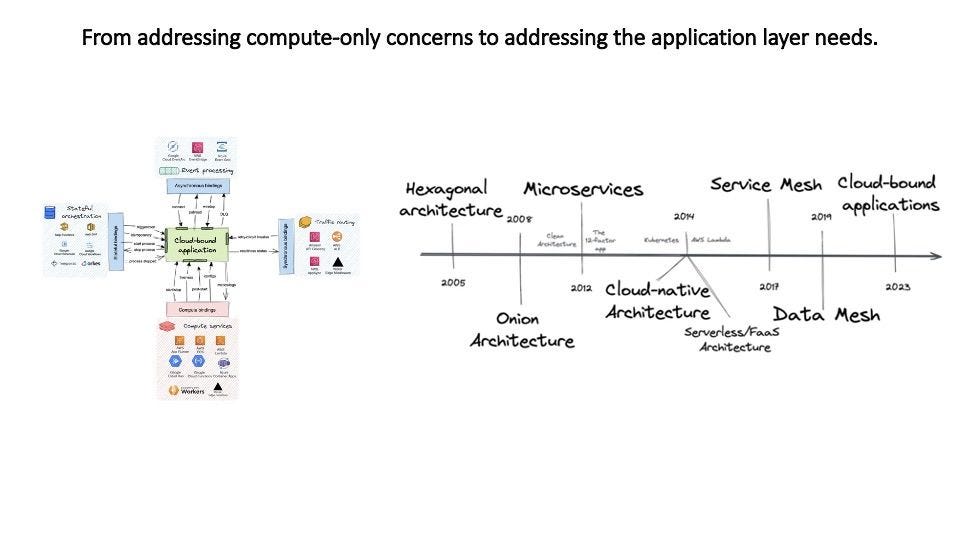
The increasing adoption of application-first cloud services is causing applications to blend with the cloud services at levels much deeper than before. The integration boundaries are shifting from database and message broker access only to one where the mechanical parts of the applications are blended and running within the cloud. The external architecture is where an application intersects with other applications and the infrastructure which other teams and organizations in the form of specialized on-premise middleware, storage systems, or cloud services typically own.
Applications run on the cloud and consume other services by using these bindings. This move to application-first cloud services is giving rise to a new application architecture where more and more application logic is running within cloud services. To preserve the independence of an application's internal and external architectures, applications and cloud services need to be decoupled with clean boundaries at development time and deeply bound together at runtime using well-defined open APIs and formats.
When building cloud-bound applications, it is important to consider how they will interact with various cloud services and APIs, and to choose those that offer open APIs and adhere to industry standards. This will enable greater portability and flexibility, allowing the application to be easily moved between different cloud providers or environments, as well as enabling the reuse of operational practices, tools, and development patterns across projects Using open APIs and de-facto standards also provides a level of future-proofing, ensuring that the application will be able to continue to interact with cloud services as they evolve over time. This can help to minimize the risk of vendor lock-in, as well as enable faster and more efficient development by leveraging pre-existing standards and practices.
Some examples of widely adopted open APIs and standards for cloud services include RESTful APIs, OpenAPI, OAuth2, and CloudEvents. Additionally, many cloud providers offer their own proprietary APIs and services, which can also be useful for building cloud-bound applications, but should be used with caution to avoid vendor lock-in.
Leveraging open APIs and de-facto standards is an important consideration when building cloud-bound applications, and can help to enable greater flexibility, portability, and efficiency in development and operations.